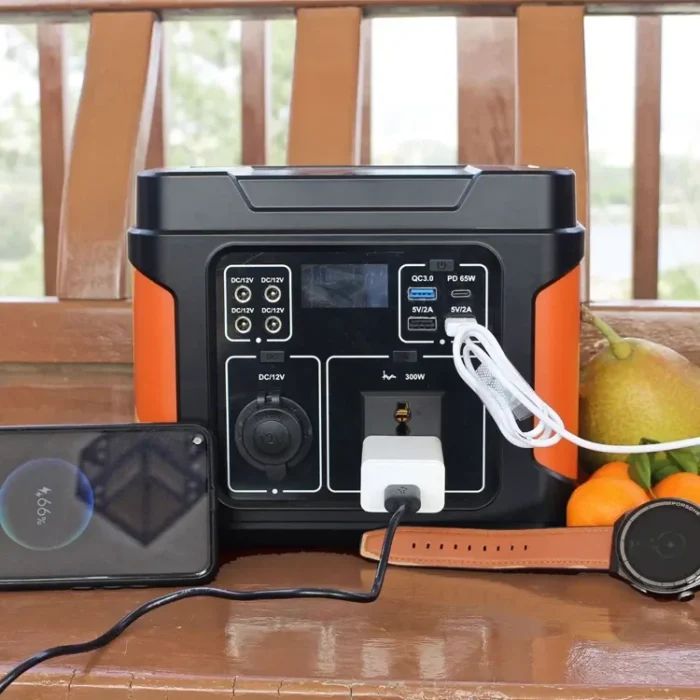
Output is what you can plug in. Capacity is for how long.
Start with output. It is the ceiling on what the inverter can drive at any one moment, and it does not care how big the battery behind it is. A 500W station will not run a 1500W kettle. Not slowly, not briefly — not at all. Capacity is the tank. Divide watt-hours by the load in watts and you get hours, roughly: a 45W camping fridge on a 450Wh station gives you about ten hours before losses. Put that same fridge on a 3840Wh station and you stop counting hours and start counting days.
So work in that order. List everything that might run at the same time — that total gets checked against output. Then decide how long it all has to run — that sets capacity. When a buyer says a station feels 'underpowered', nine times out of ten the output was fine and the tank was too small. Or the other way round. Rarely both.
The 500W class: camping and light duty
Our BPS-500W carries 450Wh. Take a weekend camp list and run it against the figure. LED lights at 10W for five evening hours take 50Wh. Phones and tablets take roughly 30Wh across a weekend. A laptop top-up at 45W for two hours takes 90Wh. A fan at 15W for six hours takes another 90Wh. That leaves around 190Wh for the 12V fridge: a 40W fridge on a one-in-three duty cycle draws about 13W on average, so the remaining budget covers it through the night with margin to spare.
The line for this class is simple: electronics yes, heat no. The second a customer says the word 'kettle' — or heater, or power tools — stop selling the 500W and walk them up a class. That conversation is much easier before the purchase than after the first cold morning.
The 1000W and 2000W classes: the working middle
At 1000W, a power station stops being a gadget and becomes a tool: the change is the output ceiling — loads a 500W inverter cannot start at all sit inside a 1000W unit's rating. Our BPS-1000W sits in this class; the BPR-2000W adds headroom on top, plus wireless charging and a third charging method — the step up is output, and the choice between the two is made off the simultaneous-load total, not the capacity figure.
This is also where UPS behaviour starts to matter. The 1000W UPS station in this range carries pure sine wave output and MPPT solar charging; for a home office or a small shop's till and router, the figure to ask for is the switch-over specification, confirmed with the quotation. A camping station is simply not built for that job.
The 3000W and 5000W classes: backup that means it
Above 3000W the purchase changes character. The BPS-3000W (3000W of output, 3840Wh) and the BPS-5000W (5000W, 5120Wh) are the deliberate end of the range — purchases sized against a written load list, not impulse buys. The arithmetic is the same as every other class: list the loads, total the watts, multiply by the hours the backup has to cover, and check the result against the capacity figure.
Be straight with customers about the weight, though. A 5120Wh battery is not luggage. It is a wheeled piece of furniture, and for distributors it is freight, not a parcel — price that into the programme from day one. What the customer gets in return is capacity in depth: watt-hours behind a written list, checked before the order rather than discovered during the outage.
A sizing worksheet you can steal
Here is the worksheet. Steal it. Each load, its watts, the hours it runs per day; multiply across, add the column down, and that is your daily capacity need. Then add a quarter — inverter losses and battery reserve are real, and pretending otherwise is how systems disappoint. Finally, check the largest simultaneous total against the output classes. And if the daily number shocks the customer, the answer is usually not a bigger station. It is taking the thermal loads — kettles, heaters, hairdryers — off the backup list. Heat eats batteries. It is always the heat.
One more case: solar-first use — off-grid cabins, boats, site work. There, size the panel to the daily consumption, not to the station. A station that empties every day and refills every day is a well-matched system, whatever class it happens to be.
Three worked examples
Example one, a weekend camper. LED lights, 20W for five hours. Two phones. A laptop for two hours. And a 45W fridge running half the day. Add it up: roughly 100 + 30 + 90 + 540 = 760Wh a day. Too much for the 450Wh station: the day's list is the test, and 760Wh does not fit inside 450Wh. The station for this list is the one whose stated capacity clears it with margin. And notice: it is the fridge that decides. Not the electronics. It is almost always the fridge.
Example two, a home office somewhere the grid cannot be trusted. Router 10W, laptop 60W, monitor 30W, one light 10W — 110W across an eight-hour working day is about 880Wh, plus the fridge if it shares the circuit. The station for this list is the one whose stated capacity clears roughly 880Wh with margin; the 2000W figure on a station in this class is output, and output is not what runs out here. The output barely gets used here. Capacity is the whole point.
Example three, a smallholding with a well pump. The pump draws 1200W in bursts, so the 500W and 1000W stations are out on output alone — capacity never even enters the argument. When a motor is on the list, output decides first. Capacity argues afterwards.
A worked example: the weekend camp
Take a typical two-day camp setup. A 60W camping fridge running half the day uses roughly 700Wh across a weekend; LED lighting at 10W for five hours an evening adds about 100Wh; two phones and a camera battery are rounding errors at perhaps 60Wh in total. Call it 900Wh with a sensible margin, before inverter and conversion losses.
Set against the capacities, that weekend sits beyond a single charge of the 500W station (450Wh) unless the fridge is efficient and the weather kind — but add the foldable solar panel during the day and the arithmetic changes completely, because the fridge's biggest hours are the sunny ones. Without solar, the honest answer is the arithmetic again: a station whose stated capacity clears the 900Wh, chosen by the capacity figure rather than by the output class on the box. That is the sizing conversation in miniature: loads first, hours second, panel third, and the battery last.
A second worked example: backup for a small home
Take the outage case, because it is the one buyers size worst. The loads that matter are rarely the dramatic ones: a fridge cycling through the day, a router that must never drop, lighting for the evening, phones, and a television for the news. Call the fridge 150Wh across a day of cycling, the router 240Wh for a full day, lighting and devices another 200Wh — roughly 600Wh a day for a household running its essentials and nothing else.
Set against the capacities, that day sits inside the 3000W class's 3840Wh with room for a second and a third day, and inside the 5000W class's 5120Wh with room to spare — while the output question barely matters, because none of those loads is large. Backup sizing is capacity sizing. Output sizing is motor sizing. Confusing the two is how households end up with a station that can run a circular saw for twenty minutes but not a fridge for a weekend.
Wholesale inquiries
Tell us the model, your quantity and your market — we reply with a quotation and lead time.