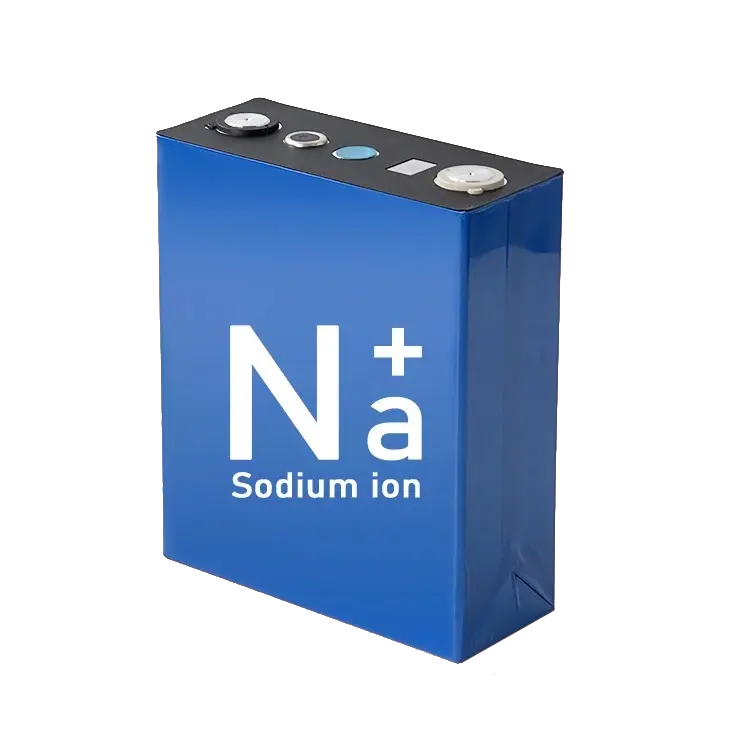
3.2V cell specification in full
Note the wide operating window — sodium-ion cells discharge down to 1.5V, so pack design and BMS settings differ from a lithium programme; talk to us before you commit a design.
| Nominal voltage | 2.92V |
|---|---|
| Operating voltage | 1.5V – 3.95V |
| Rated energy | 671.6Wh |
| Standard continuous discharge | 115A |
| Maximum continuous discharge | 230A |
| Standard continuous charge | 115A |
| Maximum continuous charge | 230A |
| Dimensions (L×W×H) | 175 × 72 × 207 mm |
| Weight | 5.1 kg |
Where the 3.2V cell is used
The cell's current ratings are 115A continuous and 230A maximum, in charge and discharge alike. The NFPP cell is the catalogue's other cell line: a poly-anion sodium-ion cell for commercial and industrial energy storage, backup power and renewable energy systems.
Reading the cell's operating window
The figure that surprises lithium engineers first is the window: 1.5V to 3.95V, around a 2.92V nominal. Sodium-ion's discharge curve slopes across that whole range instead of holding a plateau, and that changes two design habits. State-of-charge estimation cannot lean on a flat voltage curve, and the pack's usable energy depends on how much of the window your electronics can actually work across.
Design for the window: the operating window is 1.5–3.95V, and the current ratings are 115A continuous and 230A maximum in both directions. A pack design — its BMS settings, its enclosure, its charge regime — is worked against those figures from the start.
Charge and discharge: 115A continuous, 230A maximum
Both directions carry the same ratings — 115A continuous as the standard rate, 230A as the maximum — which is what makes this a power cell rather than a pure energy cell. For pack design the two directions are specified independently: the discharge configuration is worked from the continuous and maximum figures, and the charge regime is worked from the same pair — 115A standard, 230A maximum.
Size the pack from the continuous figure and treat the maximum as headroom for peaks. If your duty cycle lives near the maximum for long stretches, tell us: the right answer may be more cells in parallel rather than a smaller pack worked harder, and that is a design conversation worth having before tooling, not after.
The 671.6Wh building block
Each cell carries a rated energy of 671.6Wh in a 175 × 72 × 207 mm case at 5.1 kg, so pack arithmetic starts from a substantial unit.. The prismatic format stacks and clamps conventionally. The case dimensions are the ones in the specification — 175 × 72 × 207 mm — and an enclosure is designed against them for the configuration being built.
For logistics planning, the 5.1 kg unit weight is the figure to work with — cells ship as heavy freight, and pallet and packaging planning should start from it.
Cell or finished pack?
Everything on this page is a bare cell, supplied for your own pack production. A buyer who would rather not assemble should look at the finished batteries in the starter, forklift and storage ranges instead: those are complete products with their own specifications, not these cells in a case.
Ordering the 3.2V cell
Tell us the pack configuration you are building (series/parallel, target voltage and capacity) and your cell quantity. The cell's figures — 2.92V nominal, a 1.5–3.95V operating window, 175 × 72 × 207 mm and 5.1 kg — are the basis the quotation is worked from.
Wholesale inquiries
Tell us the model, your quantity and your market — we reply with a quotation and lead time.