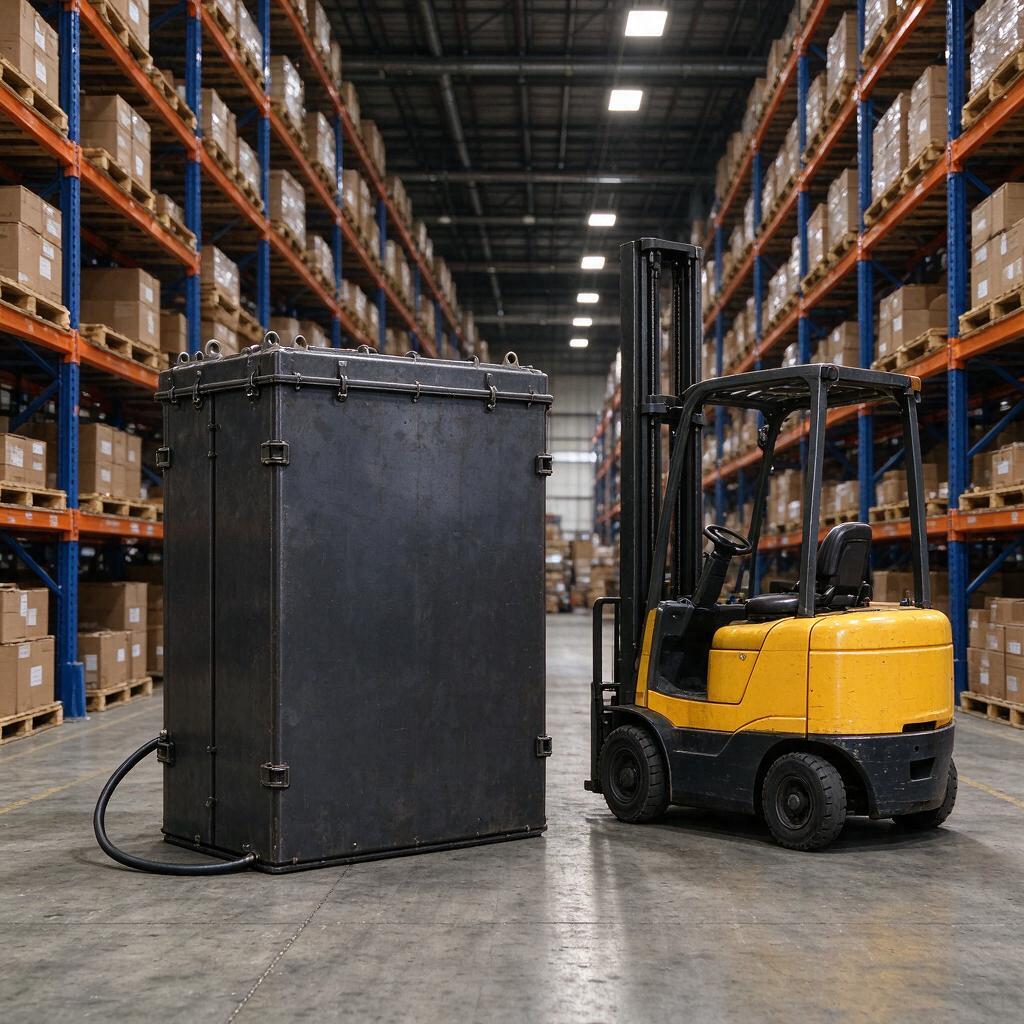
Built around your trucks
A forklift battery is also a counterweight, so a replacement pack has to match the original's dimensions and approximate weight as well as its voltage. Send us the truck model, the existing battery's dimensions and capacity, and your shift pattern with your inquiry, and we will quote against those measurements.
Charging is the other half of the project. Fast charging and a −40°C to 60°C working range are stated on the shop's forklift listings. For a multi-shift fleet, send the break pattern with the truck list: the charge pattern is part of the quotation, worked against the shifts the pack has to cover.
48V pack specification
| Nominal voltage | 48V (24V / 36V / 72V / 80V / up to 96V also built) |
|---|---|
| Capacity classes | 100Ah – 600Ah, to order |
| Reference build | 48V 160Ah NFPP custom pack |
| Cycle life class | 3,000–6,000 cycles |
| Chemistry options | Sodium-ion, incl. poly-anion NFPP |
| Low-temperature operation | Fast charging; working range −40°C to 60°C |
| Fitment | Built to order — quote against the truck model and the existing battery's dimensions |
Specifying the pack around the truck
Three measurements decide a forklift pack before chemistry is even discussed. The tray: length, width, height, and the cable exit position. The mass: a traction battery is part of the truck's counterweight system, so the replacement must bring the total back to the original's approximate weight, with ballast inside the case if the chemistry runs lighter. And the connector: type and position, which the pack has to match.
Send those with the truck model and the old battery's voltage and capacity. Tray dimensions, mass and connector are the measurements the build is quoted against — on a counterbalance truck, they are the specification, not a detail.
Duty cycles: one shift or three
Shift pattern is the capacity question in disguise. A single-shift truck on a nightly charge is one sizing problem; a three-shift truck is another, and it is the one sodium-ion changes most.
Tell us the shifts per day, the break pattern and the charger situation, and the capacity class — the family builds from 100Ah to 600Ah — can be matched to the duty rather than guessed at. Undersized packs get worked to death; oversized ones are money parked in the tray.
The family context matters at quotation: one conversation covers the 24V, 36V, 72V, 80V and 96V classes if the fleet mixes truck sizes, and one shop listing for the family is published at 3,000 to 6,000 cycles, with IP67 sealing and smart BMS options. Send the charger make and its settings with the truck list — the charging profile differs from lead-acid, so the charger is specified with the pack rather than carried over on assumption.
The conversion programme
A conversion can be staged. One truck first — ideally the hardest-worked one — run for a month against the lead-acid trucks it works beside, with charging time, downtime and driver feedback recorded. Then the rollout by truck group, with chargers replaced or reprogrammed as part of the same project, not discovered afterwards.
Our forklift guide works through the full data checklist — data plate, dimensions, weight, connectors, chargers, environment — and is the document to hand to whoever collects the fleet data before you inquire.
Ordering a 48V forklift pack
We need: truck make and model, current battery voltage/capacity/dimensions, charger type, and shifts per day. Send that list with your inquiry; the quotation is worked against it, charger pairing included.
Wholesale inquiries
Tell us the model, your quantity and your market — we reply with a quotation and lead time.