Start with what the engine asks for
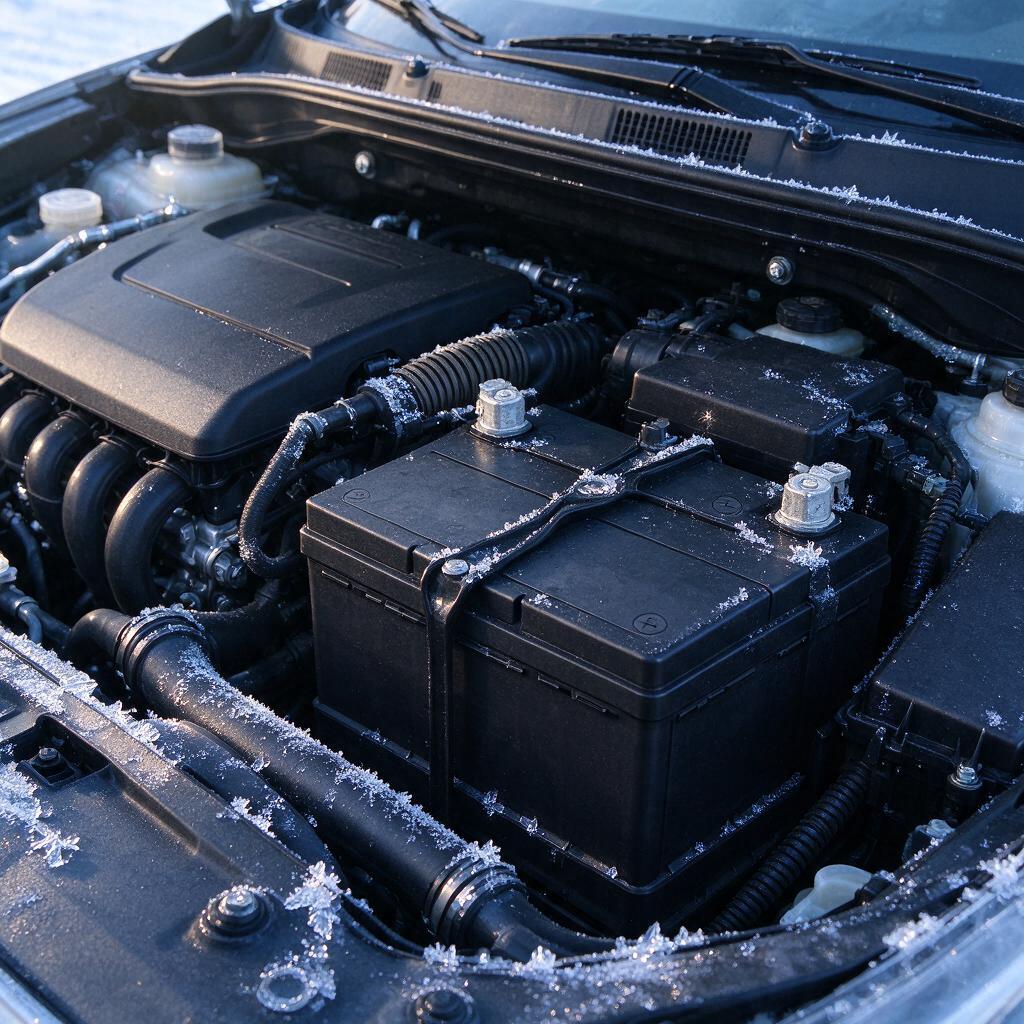
A starter motor does not care about your battery's capacity in amp-hours. It cares about one burst: several hundred amps, for a few seconds, from a battery that may have sat outside all night at −25°C. Thick engine oil makes that burst harder at exactly the moment the battery is least able to deliver it. Any chemistry comparison that ignores this is marketing, not engineering.
So judge the two chemistries on three things: how much of their room-temperature discharge they keep in the cold, how they handle very high discharge rates, and how fast they accept charge afterwards — because a car that does short winter trips needs the battery to refill quickly, too.
The cold numbers
Our core 30Ah sodium-ion starter model is rated at 90% discharge at −20°C and 80% at −40°C. Those are the figures the starter family is built around, and they are the reason sodium-ion exists in this catalogue at all. The chemistry's ionic conductivity simply falls off more gently as temperature drops.
LiFePO4 is a fine chemistry — we sell a lot of it — but cold is its weak direction. Lithium iron phosphate cells lose capacity quickly below freezing, and charging a LiFePO4 battery below 0°C without heating risks permanent damage to the cells, which is why better LiFePO4 products carry low-temperature charge cut-offs. For a storage battery in a garage that rarely matters. For a starter battery in Manitoba or Mongolia, it is the whole decision.
What the cell data shows
Look at the two prismatic cells side by side and the personalities show. The sodium-ion cell works across a 1.5V to 3.95V window with a nominal 2.92V — a wide, sloping discharge curve. It is rated at 671.6Wh in a 175×72×207mm format at 5.1kg, with 115A continuous and 230A maximum current in both directions. The comparable LiFePO4 cell runs 2.5V to 3.65V around a 3.2V nominal, stores 736Wh in a slightly slimmer 174×54×207mm case at 4.1kg.
Read plainly: the LiFePO4 cell packs more energy into less weight and volume. If your product is carried, flown or worn, that matters and lithium wins. But a starter battery sits in a tray. What it needs is current in the cold, and on that measure — plus, on the 30Ah battery built from this chemistry, 3C charging, 5C continuous discharge and a 20C cranking burst — the sodium-ion side is the stronger tool.
Cycle life and the economics nobody prints
Our 30Ah and 75Ah sodium-ion starter models are each rated at 6,000 cycles or more. A starter battery in normal use shallow-cycles, so in practice the battery's life is governed by calendar ageing and abuse tolerance rather than cycle count — and sodium-ion tolerates the two abuses that kill car batteries, deep discharge and sitting discharged, far better than lead-acid and with less drama than lithium.
Then there is the input cost argument. Sodium is abundant and cheap; there is no lithium, cobalt or nickel in the cell. Prices move, and we would not build a buying decision on any single month's spread, but the structural direction is clear: sodium-ion removes the most volatile raw material from the bill. For distributors pricing a three-year programme, that stability is worth money.
So which should your programme carry?
For starting in cold climates: sodium-ion, and it is not close. The discharge retention at −40°C, the cranking burst, the fast charge acceptance and the abuse tolerance all point the same way, which is why our starter family is sodium-ion only.
For portable power and home storage, where the battery lives indoors, cycles daily and is judged on energy per kilogram, LiFePO4 remains an excellent answer — it is what our power stations and wall batteries are built on. The honest position is that the chemistries are good at different jobs. Match the chemistry to the job, and be suspicious of any supplier who tells you one of them wins everywhere.
One more practical point: charging in the cold
Fleet buyers ask about discharge and forget to ask about the drive home. A vehicle that starts at −30°C then does a nine-minute trip gives its battery a nine-minute recharge window, day after day. A chemistry that accepts charge slowly in the cold — or refuses it outright below freezing, as unheated LiFePO4 must — slowly starves even if every start succeeds.
Sodium-ion accepts charge at low temperature far more readily, and our core starter model charges at a 3C rate, so those short winter trips actually replace what the start took out. When you evaluate a starter battery for a northern market, ask for the low-temperature charge figures alongside the discharge ones. A supplier who only quotes discharge is showing you half the winter.
Before you switch a fleet: the checklist
Chemistry is only the first line of the specification. Before a fleet or a distribution programme changes over, work through the physical and electrical fit: measure the battery tray and hold-downs, confirm the terminal layout and polarity against the battery being replaced, and check the case size against the dimensions for the model — a battery that cranks perfectly but does not fit the tray is the wrong battery.
Then confirm the support pack: the charging specification for the model, the warranty terms in writing, and the certification file for your market. Ask for a sample and run your own cold test at the lowest temperature your market actually sees. The suppliers worth working with — and we include ourselves in that challenge — will encourage the test rather than argue with the thermometer.
What to check before you switch a programme
However the comparison comes out, the buying discipline is the same, and it is worth stating plainly because cold-climate programmes fail on paperwork more often than on chemistry.
Ask for the discharge figures at temperature, in writing, for the exact model you are buying — not for the family, and not for a sibling model with better numbers. Ask for the low-temperature charge acceptance with the same precision. Check the case size and terminal layout against your parc's trays. Then take a sample and freeze it: your own cold test, at your market's real minimum, on a battery that has soaked overnight. A supplier confident in the figures will encourage every one of those steps; a supplier who argues with the thermometer is telling you something.
And keep the results. A programme that holds its own test data — temperatures, soak times, cranking outcomes — negotiates its second order from evidence, and settles the sodium-ion versus LiFePO4 question for its own market instead of borrowing somebody else's answer.
Wholesale inquiries
Tell us the model, your quantity and your market — we reply with a quotation and lead time.