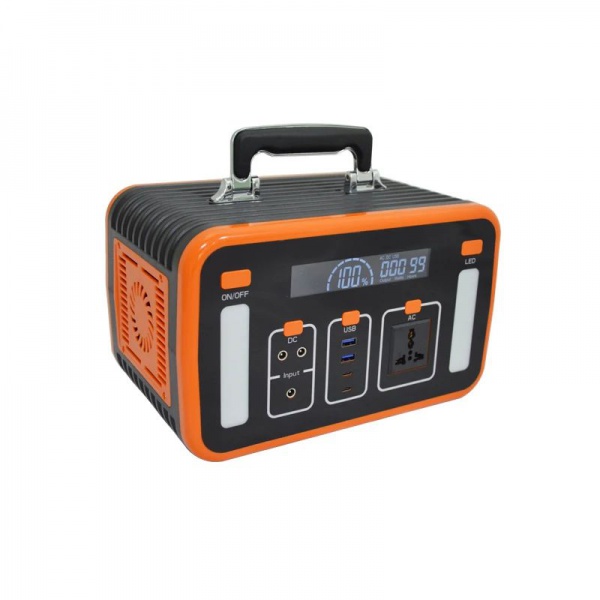
The working middle of the range
The BPS-1000W is positioned for outdoor, RV, camping and travel. It is the working middle of the range: 1000W of rated output, twice the class below it. Which loads it carries is the sizing question of the page — worked from your list below, not assigned by the class.
The unit can be supplied with your branding, on the unit and its packaging.
BPS-1000W specification in full
| Rated output | 1000W |
|---|---|
| Battery chemistry | LiFePO4 |
| Positioning | Outdoor, RV, camping and travel |
The 1000W class: what changes
Crossing from 500W to 1000W is where the load list changes. Doubling the rated output changes which lists clear the ceiling and which still have to be sequenced: the check is the same one this page works through below — running watts and start-up surges, one load at a time and in combination. The purchase is justified against a job
What runs at once on 1000W
Output budgeting is the skill to teach at the counter. A thousand watts is generous until two hungry devices coincide: a travel kettle alone can take most of it, a power tool's start-up surge can spike past its rating plate, and a heater treats the whole budget as a starting point. The honest combinations are the useful ones — tools one at a time, electronics together freely, heat almost never.
Runtime is the second half of the conversation, and it is worked from your load list, not from a headline figure: state your loads and the hours they run, and the reply works the build's capacity against them before you commit. That exchange — loads first, station second — is the whole sizing method.
A worked split makes the class concrete. A travel kettle at 800W runs alone and finishes in minutes. Power tools run one at a time, with the start-up surge counted against the same 1000W ceiling. Electronics — laptops, camera batteries, lights, a router — run together freely, because their combined draw sits far below the ceiling. The discipline is sequencing, not sacrifice: heavy loads one by one, light loads in parallel, and the counter conversation is three piles — runs alone, runs together, stays home.
The BPS-1000W in a programme
In a distributor's range this is the hinge class: the step-up from the 500W class, specified by output and worked against the load list. Stock it beside the 500W with the sizing conversation printed in your own materials — which loads, how long, what runs together — and the sizing conversation is the same for both classes.
Branding options cover the unit and its packaging for retail programmes.
Ask for the build's capacity figure with the quotation, and work the runtime from your own load list before the order is placed: output chooses the class, capacity chooses the hours, and the two figures are quoted separately so that each can be checked on its own.
Accessories and the second sale
Plan for the follow-on list at the first transaction — a foldable panel, a storage battery, a second unit — all in the same catalogue, and all quotable alongside the first order.
Keep the customer's load list on file from the first conversation.
Ordering the BPS-1000W
Tell us your market's socket standard and your branding requirements, plus target quantity, and we will quote. If your programme needs a specific capacity point, ask — the line is configured in steps and we will match the closest build.
Wholesale inquiries
Tell us the model, your quantity and your market — we reply with a quotation and lead time.